.jpg)
What Is ROI in Healthcare? How to Measure Marketing Performance and Drive Growth
Read More


Patients no longer arrive at a medical practice without context. Before booking an appointment, they research symptoms, compare providers, read educational content, and evaluate credibility across digital channels. In this environment, inbound marketing for doctors has become one of the most effective ways to attract and retain patients by earning trust rather than pushing messages.
Inbound marketing aligns naturally with how patients make healthcare decisions. By delivering relevant information, demonstrating expertise, and maintaining consistent communication, medical practices can build stronger relationships long before the first visit. This article outlines how inbound marketing works in healthcare today, which strategies matter most, and how practices can create a sustainable system that supports growth and patient confidence.
Inbound marketing focuses on attracting patients through value-driven content and experiences instead of interruptive advertising. For medical practices, this means showing up with credible information at the exact moment patients are searching for answers.
Effective inbound marketing for doctors combines content marketing, search visibility, email nurturing, and patient resources to guide people from initial research to appointment scheduling. Rather than promoting services aggressively, practices build authority by addressing patient concerns and explaining care options clearly.
This approach reflects broader shifts in healthcare inbound marketing, where transparency, education, and trust are the primary drivers of patient acquisition.
High-quality content sits at the core of any inbound strategy. In healthcare, content does more than inform; it reassures patients that a practice understands their needs and takes their concerns seriously.
Strong inbound content for medical practices includes:
Over time, consistent content builds familiarity and authority. Patients who encounter a practice repeatedly during their research phase are more likely to trust it when they are ready to take action. These touchpoints align closely with the stages outlined in the inbound marketing funnel, where attraction and engagement naturally lead to conversion.
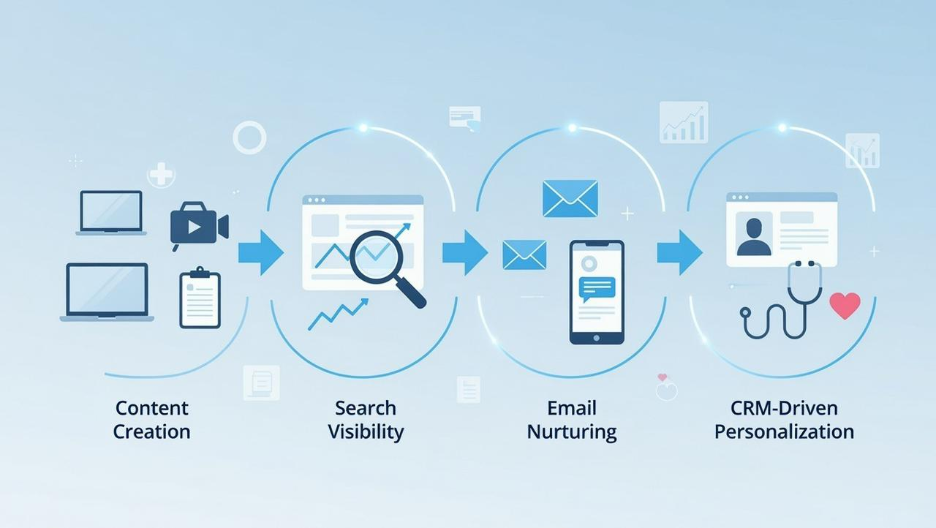
Search visibility is essential to inbound success. Patients rely heavily on search engines to find both medical information and providers, making SEO one of the most important healthcare marketing techniques for long-term growth.
Effective healthcare SEO focuses on:
When SEO and content work together, practices reach patients earlier in their decision-making journey, often before competitors become visible.
Inbound marketing does not stop once a patient visits your website. Email plays a critical role in nurturing relationships and reinforcing trust over time.
For medical practices, email supports inbound marketing by:
When integrated thoughtfully, email strengthens inbound efforts rather than feeling promotional. This connection between inbound strategy and email nurturing is explored further in our guide on how email marketing fuels your inbound strategy, which highlights how consistent, relevant communication improves engagement and retention.
Patients want to understand not only what a practice offers, but how it approaches care. Storytelling allows medical practices to communicate values, empathy, and purpose without relying on patient-specific claims.
Effective storytelling in healthcare might include:
These narratives humanize the practice and help differentiate it in competitive markets. Within inbound marketing, storytelling reinforces trust by setting clear expectations and emotional reassurance.
As inbound strategies mature, personalization becomes increasingly important. A CRM in the healthcare industry allows practices to understand patient behavior and tailor communication accordingly.
With the right CRM tools, practices can:
This data-driven approach creates a seamless experience from first interaction to long-term care, strengthening trust at every stage of the patient journey.
Inbound marketing is not limited to patient acquisition. It also supports healthcare organizations that serve referral partners, multi-location practices, and healthcare service providers operating in B2B environments.
For these organizations, inbound marketing helps:
Inbound strategies scale effectively across patient-facing and B2B healthcare models when built on consistency and credibility.
Inbound marketing is a long-term system, not a one-time campaign. Practices that succeed commit to ongoing content development, SEO optimization, email nurturing, and performance analysis.
Over time, this approach delivers:
When strategy, execution, and technology align, inbound marketing becomes a reliable growth engine.
In a healthcare landscape shaped by informed, digitally engaged patients, inbound marketing for doctors offers a sustainable path to growth rooted in trust. By educating patients, improving visibility, nurturing relationships, and personalizing communication, medical practices can attract the right patients consistently without relying on aggressive advertising.
If you’re ready to build an inbound marketing strategy that supports long-term growth and patient confidence, schedule a consultation with North Vista Marketing to explore how inbound marketing can be tailored to your practice’s goals and patient population.
.jpg)