.jpg)
What Is ROI in Healthcare? How to Measure Marketing Performance and Drive Growth
Read More




Healthcare organizations are facing increasing pressure to improve access, reduce administrative strain, and deliver consistent patient experiences all while managing limited staff and rising demand. This is where voice AI healthcare is emerging as a strategic advantage.
More than a tool for answering calls, voice AI introduces intelligent, workflow-driven automation that supports patient communication, optimizes front-desk operations, and creates measurable operational efficiencies. From AI patient intake to real-time scheduling and after-hours support, AI voice agents are redefining how modern healthcare systems manage patient flow.
Front-desk operations are often one of the most resource-intensive areas in healthcare. High call volumes, repetitive administrative tasks, and fragmented communication workflows can lead to inefficiencies, missed opportunities, and staff burnout.
Voice AI healthcare addresses these challenges by introducing structured, scalable automation that can:
For healthcare leaders, this translates into improved operational performance without increasing overhead.
The value of ai voice agents for healthcare lies in their ability to integrate into existing workflows and enhance them without disrupting clinical operations.
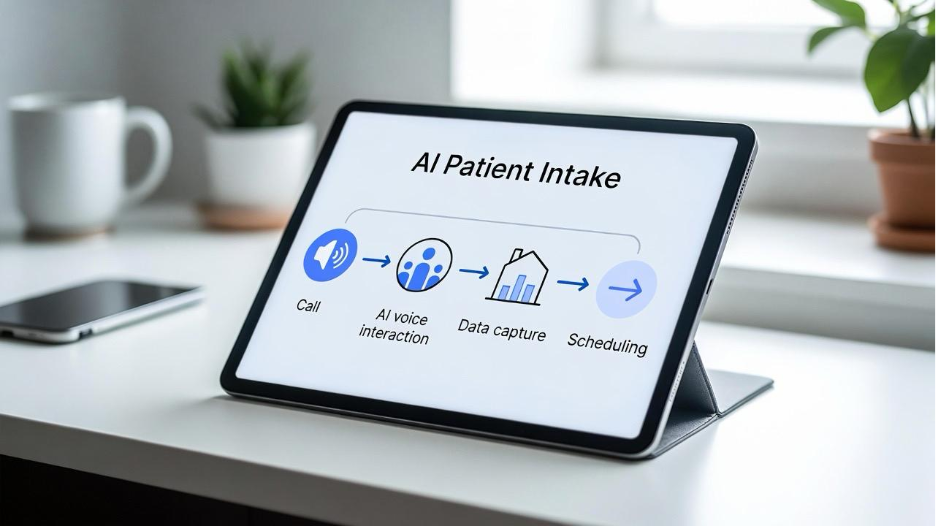
AI Patient Intake That Improves Data Accuracy and Workflow Readiness
Traditional intake processes are often time-consuming and prone to inconsistencies. With ai patient intake, organizations can standardize and streamline how patient information is collected.
AI voice agents can:
This ensures that providers have accurate, actionable information before the patient encounter, improving both efficiency and care delivery.
Scheduling is a critical operational function that directly impacts revenue and patient satisfaction. Voice AI enhances this process by:
This reduces scheduling errors, improves resource utilization, and increases appointment capture rates.
Healthcare demand does not operate on a fixed schedule. Patients often seek care outside of standard business hours, and missed calls represent missed opportunities.
With voice AI healthcare, organizations can:
This ensures that patient access is not limited by staffing constraints.
Administrative questions consume a significant portion of front-desk capacity. Voice AI can handle high-frequency inquiries such as:
By automating these interactions, organizations reduce administrative load while maintaining a high standard of communication.
Selecting the best voice ai for healthcare front-desk automation requires evaluating both performance capabilities and healthcare-specific requirements. The goal is not just automation, it is intelligent, reliable, and compliant execution.
Effective voice AI must understand patient intent clearly and respond in a conversational, human-like manner. High accuracy ensures that interactions remain efficient and professional, even in complex scenarios.
Data protection is foundational. Any voice AI healthcare solution must:
This protects both patients and the organization while reinforcing trust.
Operational efficiency depends on connectivity. Voice AI solutions should integrate directly with:
This eliminates redundant data entry and ensures continuity across workflows.
Healthcare organizations require flexibility. The most effective solutions allow customization of:
This ensures that voice AI adapts to the organization—not the other way around.
For decision-makers, the value of voice AI healthcare is best understood through measurable outcomes.
Organizations that implement AI voice agents typically see:
These outcomes position voice AI not as a cost center, but as a growth enabler.
Administrative overload remains one of the most significant challenges in healthcare operations. Repetitive tasks and constant interruptions limit staff efficiency and impact morale.
By implementing ai voice agents for healthcare, organizations can:
This creates a more sustainable work environment while improving overall performance.
Voice AI is most effective when integrated into a broader digital ecosystem. Patients engage through multiple channels, and consistency across those channels is essential.
Combining voice automation with digital tools such as North Vista’s AI chatbot solutions, creates a cohesive communication experience across phone, website, and messaging platforms. You can explore how this integrated approach works through North Vista’s AI chatbot services, which complement voice-based systems by supporting real-time digital engagement.
This unified strategy ensures that patients receive consistent, reliable support regardless of how they interact with the organization.
Healthcare organizations that adopt voice AI healthcare are building systems designed for long-term scalability. As patient demand continues to grow, the ability to manage communication efficiently becomes a competitive advantage.
Key strategic benefits include:
These advantages support both immediate efficiency gains and long-term growth objectives.
The evolution of healthcare operations is increasingly driven by intelligent automation. Voice AI healthcare provides a practical pathway to modernize front-desk workflows, improve patient access, and support staff without adding complexity.
By streamlining ai patient intake, optimizing communication, and integrating with existing systems, AI voice agents enable healthcare organizations to operate more efficiently while delivering a higher standard of care.
For healthcare leaders evaluating how to implement these capabilities within their organization, a structured approach is essential. You can explore tailored solutions or connect with a specialist through North Vista’s appointment page to begin building a more efficient, scalable patient communication strategy.
.jpg)