.jpg)
What Is ROI in Healthcare? How to Measure Marketing Performance and Drive Growth
Read More


.png)


Digital marketing generates enormous amounts of data, yet many organizations still struggle to understand exactly where their website traffic and leads originate. Campaigns may run across multiple platforms: email, social media, paid advertising, and search, making it difficult to attribute performance accurately.
Understanding what are UTM parameters provides a clear solution. These small tracking tags attached to URLs allow marketers to identify precisely where traffic comes from and which campaigns generate meaningful engagement. When implemented correctly, UTM tracking transforms scattered analytics data into structured insights that reveal the true return on marketing investments.
For healthcare organizations, B2B companies, and professional services firms, this level of clarity is essential. Marketing leaders need reliable reporting to understand which strategies drive patient inquiries, lead generation, and long-term growth.
To understand what are UTM parameters, it helps to think of them as tracking labels added to a website link. A UTM parameter is a short piece of text appended to the end of a URL that communicates information about the source of a visitor.
For example, a standard website link may appear as: https://www.examplewebsite.com
When tracking parameters are added, the link may look like this: https://www.examplewebsite.com/utm_source=facebook&utm_medium=social&utm_campaign=spring_promotion
These additional tags allow analytics platforms such as Google Analytics to categorize traffic according to the campaign that generated it.
In practical terms, Utm parameters refers to this structured tagging system that enables marketers to track the performance of specific marketing activities.
Without structured tracking, marketing analytics can become difficult to interpret. Traffic may appear in analytics dashboards, but identifying the specific campaign that generated it becomes challenging.
Understanding UTM parameters allows marketing teams to connect traffic directly to campaign activity. Instead of guessing which marketing channel produced results, teams gain access to measurable data.
UTM tracking helps organizations:
For healthcare and B2B organizations, these insights are critical when allocating marketing budgets or evaluating the success of digital initiatives.
To fully understand how to use utm tracking effectively, marketers should become familiar with the primary parameters used in campaign links.
The source parameter identifies the platform responsible for sending traffic to the website. Common sources include:
Example parameter:
utm_source=facebook
The medium indicates the type of marketing channel being used.
Common examples include:
Example parameter:
utm_medium=social
The campaign parameter identifies the specific initiative associated with the link.
Example:
utm_campaign=summer_promotion
Additional parameters provide deeper insights into campaign performance.
UTM Term is often used to track paid search keywords.
UTM Content distinguishes variations within the same campaign, such as multiple ad creatives.
Together, these parameters create a standardized framework that allows analytics platforms to organize marketing traffic accurately.
Once marketers understand what are UTM parameters, implementing them across campaigns becomes straightforward. UTM links can be applied to nearly every digital marketing channel, including:
For instance, a Facebook advertising campaign might include an fb utm tracking link structured like this:
utm_source=facebook
utm_medium=paid_social
utm_campaign=clinic_awareness
When users click this link, analytics tools record the traffic source and attribute any resulting engagement or conversions to the appropriate campaign.
This structured tracking enables marketers to evaluate campaign effectiveness with far greater accuracy.
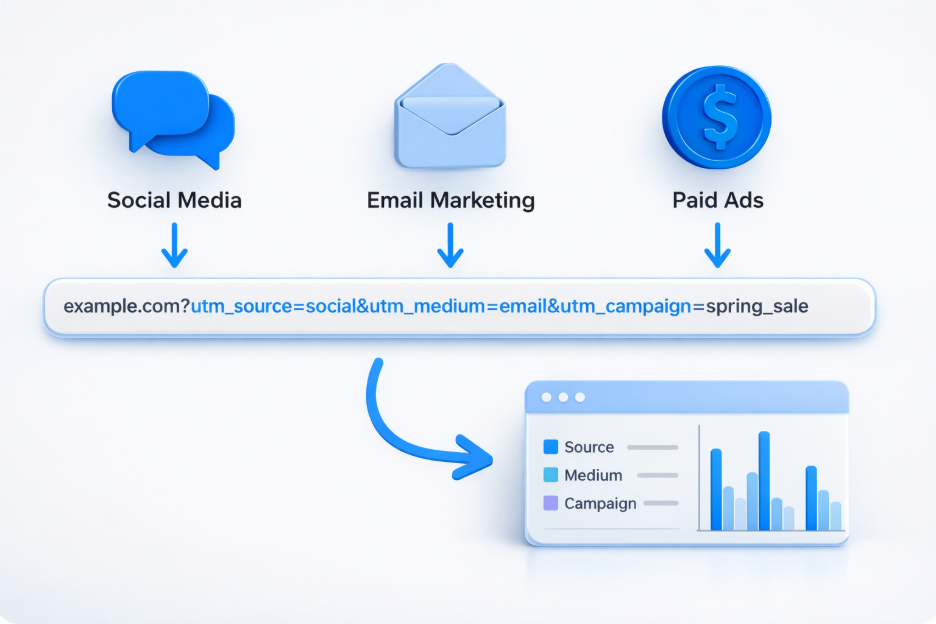
Diagram showing how to use UTM parameters to track social media, email marketing, and paid ads traffic
Manually building tagged URLs can quickly become complicated, particularly when campaigns span multiple platforms. This is where a UTM generator becomes valuable.
Using UTM generator tools helps marketers create tracking links more efficiently while maintaining consistent campaign structure and formatting.
A UTM generator allows marketers to enter campaign details such as:
The tool then automatically produces a correctly structured tracking URL.
Many organizations rely on tools like Google’s Campaign URL Builder or internal marketing dashboards to ensure campaign links follow consistent naming conventions. This consistency helps maintain clean data inside analytics platforms and simplifies performance reporting.
Once a visitor clicks a link containing a utm parameter, analytics platforms capture the information embedded in the URL. Google Analytics then organizes this data into acquisition reports that show where traffic originates.
Marketing teams can review reports such as:
These reports help answer critical questions such as:
When implemented consistently, UTM tracking turns raw traffic data into meaningful insights that guide marketing strategy.
For healthcare providers and B2B organizations, understanding what are UTM parameters plays a critical role in measuring marketing effectiveness.
Healthcare practices often promote services through multiple channels including:
Without UTM tracking, it becomes difficult to determine which channels generate patient inquiries or appointment bookings.
For example, a clinic promoting a treatment through social media can attach fb utm parameters to its campaign links. Analytics tools then track how many website visits or appointment requests originate from that specific promotion.
This data allows healthcare organizations to evaluate which marketing strategies produce measurable outcomes and which initiatives require adjustment.
Maintaining accurate data requires consistent implementation. Marketing teams should follow several best practices when using UTM tracking.
Using standardized campaign naming helps ensure analytics reports remain organized and easy to interpret.
Not every campaign requires every parameter. Only include the fields needed to produce useful reporting insights.
Applying UTM tracking consistently across advertising, social media, and email ensures complete visibility into marketing performance.
Maintaining an internal campaign tracking document helps teams remain consistent and reduces the risk of duplicate or confusing naming structures.
These practices help preserve the accuracy and usefulness of marketing analytics data.
UTM parameters allow organizations to move beyond assumptions and rely on measurable insights. With accurate tracking in place, marketing teams can clearly identify which campaigns generate traffic, leads, and conversions.
For healthcare organizations, professional services firms, and B2B companies, this level of visibility strengthens strategic decision-making. Marketing budgets can be allocated more effectively, campaigns can be optimized with confidence, and performance reports become significantly more reliable.
North Vista Marketing works with organizations that want to transform their marketing data into actionable insights. Businesses looking to strengthen campaign tracking and build clearer performance reporting can schedule a consultation with the North Vista Marketing team through the appointment page to explore how a structured, data-driven marketing strategy can support long-term growth and measurable ROI.
.jpg)